
How to Get Data Analyst Fresher Jobs in Delhi NCR, Bangalore & Pune (Salary: ₹3.5L - ₹7.0L)
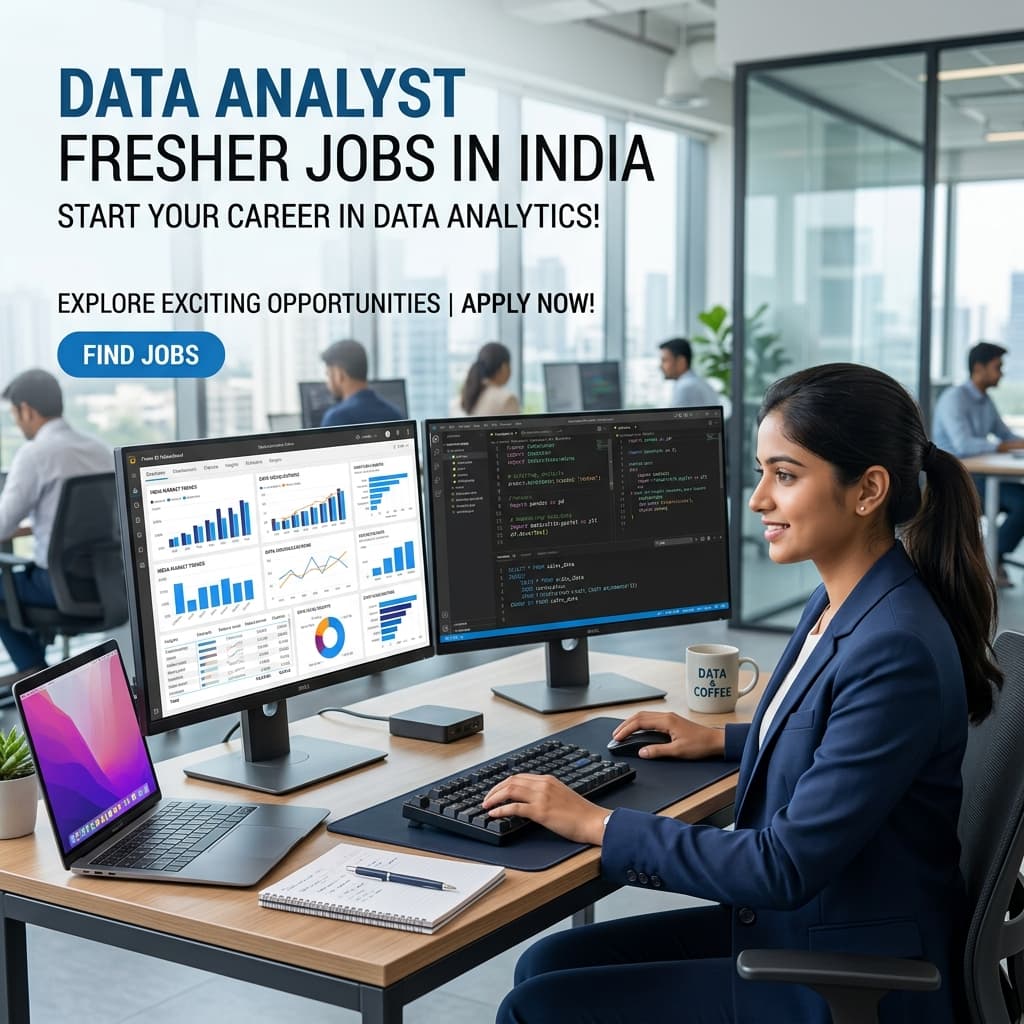
Data Analyst has emerged as one of the most lucrative and high-demand entry-level careers for graduates in India. From fast-growing fintech startups in Bengaluru and Gurugram to multinational banks in Mumbai and shared-services analytics centers in Pune, companies of every size are drowning in data and seeking skilled professionals who can extract actionable business intelligence.
According to verified placement records and recruiter data on Pagaar India, freshers possessing strong foundational skills in Microsoft Excel, SQL, and interactive BI dashboards can command starter packages ranging between ₹3,60,000 and ₹7,50,000 per annum (equivalent to ₹28,000 to ₹55,000 per month take-home), with exponential salary jumps upon completing their first 18 to 24 months.
1. The 2026 Data Analyst Salary Landscape in India (City-Wise)
Salaries for junior and entry-level data analysts vary significantly based on location, industry vertical, and technical competency. Below is the verified salary matrix across India’s primary employment hubs:
2. Core Technical Skills You Must Master Before Applying
Recruiters in 2026 do not expect freshers to build complex predictive machine learning models; instead, they rigorously test candidate fundamentals in data querying, transformation, and clear visual communication:
A. Advanced Microsoft Excel & Google Sheets
Excel remains the foundational tool for exploratory analysis across corporate India. Interviewers test:
- Lookup Functions: XLOOKUP (preferred over legacy VLOOKUP), INDEX-MATCH, and multi-condition Lookups.
- Data Aggregation: Pivot Tables, calculated fields, Slicers, and dynamic timelines.
- Conditional Logic: Nested IF, IFS, SUMIFS, COUNTIFS, and AVERAGEIFS functions.
- Data Cleaning: Text manipulation using TRIM, CONCAT, TEXTSPLIT, and Power Query basics for ETL (Extract, Transform, Load).
B. SQL (Structured Query Language)
SQL is non-negotiable. Over 90% of Data Analyst technical rounds begin with a live SQL coding screen:
- Query Fundamentals: SELECT, WHERE, GROUP BY, HAVING, ORDER BY, and LIMIT.
- Table Joins: INNER JOIN, LEFT OUTER JOIN, RIGHT JOIN, FULL OUTER JOIN, and Self-Joins with NULL handling.
- Window Functions: ROW_NUMBER(), RANK(), DENSE_RANK(), LEAD(), and LAG() for time-series comparisons.
- Subqueries & CTEs: Common Table Expressions (WITH clauses) for structured, readable modular code.
C. Business Intelligence Tools: Microsoft Power BI & Tableau
Being able to transform raw tables into interactive management dashboards is what converts interviews into offer letters:
- Data Modeling: Star schema, snowflake schema, building one-to-many relationships, and understanding foreign keys.
- DAX (Data Analysis Expressions): CALCULATE(), RELATED(), TOTALYTD(), and time-intelligence measures in Power BI.
- Visual Storytelling: Designing executive dashboards with consistent color themes, drill-through cards, and interactive filters.
D. Python Fundamentals for Data Analysis (Optional but Advantageous)
While not strictly mandatory for every junior reporting role, having Python on your resume dramatically improves your interview callback rate. Focus on:
- Pandas Library: Dataframe operations,
read_csv(),groupby(),merge(), and handling missing data withfillna()/dropna(). - NumPy: Array manipulations and vectorized mathematical operations.
- Matplotlib & Seaborn: Generating bar charts, histograms, heatmaps, and scatter plots to validate statistical distributions.
3. Step-by-Step Portfolio Roadmap for Freshers with Zero Work Experience
College marks and degrees alone rarely convince hiring managers. A working portfolio showcasing real-world problem solving will set you apart from thousands of applicants:
- Select Real Datasets: Avoid overly used generic datasets like Titanic or Iris flower. Instead, source datasets from Kaggle or data.gov.in covering Indian e-commerce delivery delays, Swiggy/Zomato restaurant ratings, Delhi metro ridership trends, or IPL cricket match statistics.
- Document Your Business Problem: Frame your project around a genuine corporate question (e.g., "How can an e-commerce brand reduce return-to-origin (RTO) rates in Tier-2 Indian cities?").
- Publish on GitHub and NovyPro: Host your cleaned SQL scripts on GitHub with a comprehensive
README.md. If using Power BI, publish your interactive report on NovyPro so recruiters can interact with live filters directly from your resume link.
4. Top 6 Technical Interview Questions Asked to Freshers
Q1: What is the operational difference between WHERE and HAVING in SQL?
Answer: WHERE is used to filter individual records before any grouping or aggregation takes place. In contrast, HAVING is used to filter aggregated data groups created by the GROUP BY clause. For example, WHERE salary > 30000 filters rows first, whereas HAVING COUNT(employee_id) > 10 filters department groups after aggregation.
Q2: What is the difference between RANK() and DENSE_RANK() window functions?
Answer: Both assign ranks based on an ordered column. However, when there is a tie (duplicate values), RANK() skips subsequent ranking numbers (e.g., 1, 2, 2, 4), whereas DENSE_RANK() does not skip ranks (e.g., 1, 2, 2, 3).
Q3: How do you handle missing values or outliers in a dataset?
Answer: First, I investigate why the data is missing (MCAR vs MAR). For numeric columns, I impute using the median if the distribution is skewed by outliers, or mean if normally distributed. For categorical data, I impute using the mode or label it as 'Missing/Unknown'. For extreme outliers, I determine whether they are data-entry errors or valid edge cases, applying capping (winsorization) or trimming where appropriate.
Q4: What is the difference between a Star Schema and a Snowflake Schema?
Answer: In a Star Schema, a central fact table connects directly to de-normalized dimension tables, resulting in simpler queries and faster performance. In a Snowflake Schema, dimension tables are normalized into multiple sub-tables to eliminate redundancy, which requires more complex SQL joins but saves disk space.
5. How to Avoid Placement Consultant Scams
Due to the high demand for Data Analyst roles, fraudulent recruitment consultancies frequently post fake job offers on WhatsApp or Telegram, asking freshers to deposit ₹2,000 to ₹5,000 for "mandatory background verification" or "guaranteed interview scheduling". Remember: Legitimate corporate employers and genuine hiring teams NEVER charge candidates any registration fees.
All job openings on Pagaar India are 100% free for job seekers. You apply directly to verified HR departments with zero fees and zero middleman commissions.
6. Launch Your Data Analyst Career Today
Ready to start your data journey? Explore verified job vacancies and apply directly:
- Browse IT & Software Jobs and Data Analyst Jobs on Pagaar India.
- Explore entry-level vacancies in Delhi NCR, Bangalore, and Pune.
- Build your ATS-optimized resume using our Free Resume Maker.
Need to Hire Staff?
Post your job openings on Pagaar India for 100% free and recruit verified local talent instantly.
Create Recruiter AccountLooking for a Job?
Create your profile, upload your resume, and let verified employers contact you directly.
Register as Candidate